
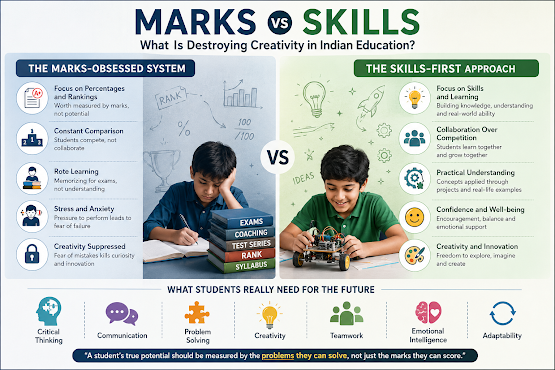
India has always valued education as the foundation of success. From board examinations to entrance tests, academic achievement is often seen as the pathway to a stable career and social respect. While education itself is empowering, the growing obsession with marks, percentages, and rankings has quietly created a system where performance is prioritized over learning. Today, many students are not studying to gain knowledge — they are studying to stay ahead in the race.
The pressure to secure high marks has become so deeply rooted in the Indian education system that a student’s confidence, identity, and future are often judged through report cards alone. In this process, an important question is being ignored: Are we preparing children for life, or simply preparing them for exams?
The Growing Rank Obsession in Indian Schools
In many schools across India, competition begins at a very early age. Students are constantly compared based on marks, sections, ranks, and academic performance. Toppers are celebrated publicly, while average students silently struggle with self-doubt. Even though schools aim to motivate students, the unintended outcome is often unhealthy academic pressure.
The focus on scoring high marks has gradually shifted attention away from creativity, curiosity, and practical understanding. Many students now study with the fear of failure rather than the joy of learning. Subjects become memorization exercises instead of opportunities to explore ideas and develop thinking skills.
This ranking culture affects students emotionally as well. Children who repeatedly fail to meet expectations may begin believing they are not intelligent enough, despite possessing talents in communication, leadership, sports, creativity, design, or problem-solving. Over time, education becomes less about growth and more about survival in a competitive environment.
Parents and Society: The Hidden Drivers of Academic Pressure
Parents naturally want the best future for their children. However, in many Indian households, academic scores have become directly linked to success, respect, and financial security. Conversations around education often revolve around percentages, ranks, and entrance examinations rather than skills or interests.
Comparison has become a common part of parenting culture. Statements like “Look at how well other children are performing” may appear harmless, but they create emotional pressure that slowly impacts a child’s confidence and individuality. Instead of discovering what they genuinely enjoy or excel at, many students start chasing external validation.
Society also reinforces this mindset. High percentages are celebrated publicly, while skills like creativity, emotional intelligence, communication, collaboration, and entrepreneurship receive far less attention. As a result, children grow up believing that marks are the only measurement of capability.
But the reality of today’s world tells a different story. Modern careers increasingly demand adaptability, critical thinking, innovation, and people skills — qualities that cannot always be measured through written examinations alone.
How Coaching Culture Intensified the Competition
The rapid growth of coaching institutes has further strengthened the idea that education is primarily about cracking exams. Large sections of students now spend years preparing for competitive tests with intense schedules, constant assessments, and performance tracking.
While coaching institutes help many students achieve academic goals, they also contribute to an environment where speed, repetition, and rank become more important than conceptual understanding. Students are trained to solve predictable exam patterns, often leaving little room for imagination, creativity, or independent thinking.
This system creates a generation of learners who may excel in structured examinations but struggle when faced with real-life decision-making, teamwork, communication challenges, or innovative problem-solving scenarios.
Education should ideally prepare students for life, not just for examinations. However, the current ecosystem often pushes students toward becoming score-focused rather than skill-focused individuals.
Is the Corporate Sector Also Supporting This Problem?
One important aspect that often goes unnoticed is the role of the corporate sector in continuing this ranking culture.
Many organizations still prioritize academic percentages, college reputation, and rankings during hiring processes. Candidates are frequently shortlisted based on marks before their communication abilities, leadership qualities, creativity, or practical skills are even evaluated. This indirectly sends a message to students that percentages matter more than actual capability.
As a result, students continue chasing marks because they believe corporate success depends entirely on academic performance.
However, companies today are also facing a growing challenge. Many employers report that graduates possess degrees but lack workplace readiness. Skills such as communication, problem-solving, emotional intelligence, adaptability, teamwork, and leadership are becoming increasingly difficult to find despite high academic scores.
In reality, some of the most valuable professionals are not necessarily the highest scorers academically. They are individuals who can think independently, collaborate effectively, handle pressure, communicate clearly, and continuously learn in changing environments.
If organizations continue evaluating talent primarily through percentages and rankings, they may unintentionally overlook highly capable individuals who possess strong practical and interpersonal skills.
The Real Cost of a Marks-Driven Education System
The biggest loss in a rank-focused system is creativity.
Children are naturally curious. They ask questions, experiment, imagine, and think differently. But when education becomes excessively performance-oriented, students slowly stop taking risks. Fear of losing marks discourages innovation and independent thinking.
Over time, students begin memorizing information rather than understanding concepts deeply. They become afraid of failure because mistakes are treated as weaknesses instead of learning opportunities.
This pressure also impacts mental and emotional well-being. Anxiety, burnout, low self-esteem, and fear of judgment have become increasingly common among students. Many children carry the burden of expectations silently, believing their value depends entirely on academic performance.
India has immense talent and potential. But if the education system continues rewarding only memorization and rankings, the country risks missing future innovators, entrepreneurs, creators, leaders, and visionaries who may not fit traditional academic definitions of success.
Building a Skill-First Education Culture
The solution is not to eliminate academic excellence. Marks and discipline still matter. However, they should not become the only definition of intelligence or success.
Schools, parents, coaching institutes, and corporate organizations all need to collectively shift toward a more balanced approach to education.
Schools can encourage project-based learning, communication development, public speaking, teamwork, creativity, and critical thinking alongside academics. Parents can focus more on effort, growth, and emotional support instead of constant comparison. Coaching institutes can integrate conceptual understanding and life skills into learning models.
Most importantly, companies can redefine hiring practices by giving greater importance to practical skills, communication abilities, adaptability, and problem-solving capabilities rather than relying heavily on percentages alone.
The future belongs to individuals who can learn, adapt, innovate, collaborate, and lead — not just memorize information.
A student’s true potential should never be measured only by the marks they score, but by the value they can create, the problems they can solve, and the person they grow into becoming.
Because education is not meant to produce rank holders alone.
It is meant to build capable, confident, and creative human beings.
With warmth,
Varun Singh
Parent | Educator | Advocate for Emotionally Intelligent Parenting
You May Also Like

-
Sep 22, 2025
Every parent wants their child to feel loved, secure, and happy. In today’s world, with increasing competition and stress, it’s...
Sign up to receive our latest updates
[mc4wp_form id=3101]
Get in touch
Call us directly?
+917410024297
Address
House No. 5/5/19, Near Udaya School, PariKrama Marg Faizabad, U.P. 224001
office.indiskool@gmail.com
Quick Links
- Indiskool – All Right Reserved 2025